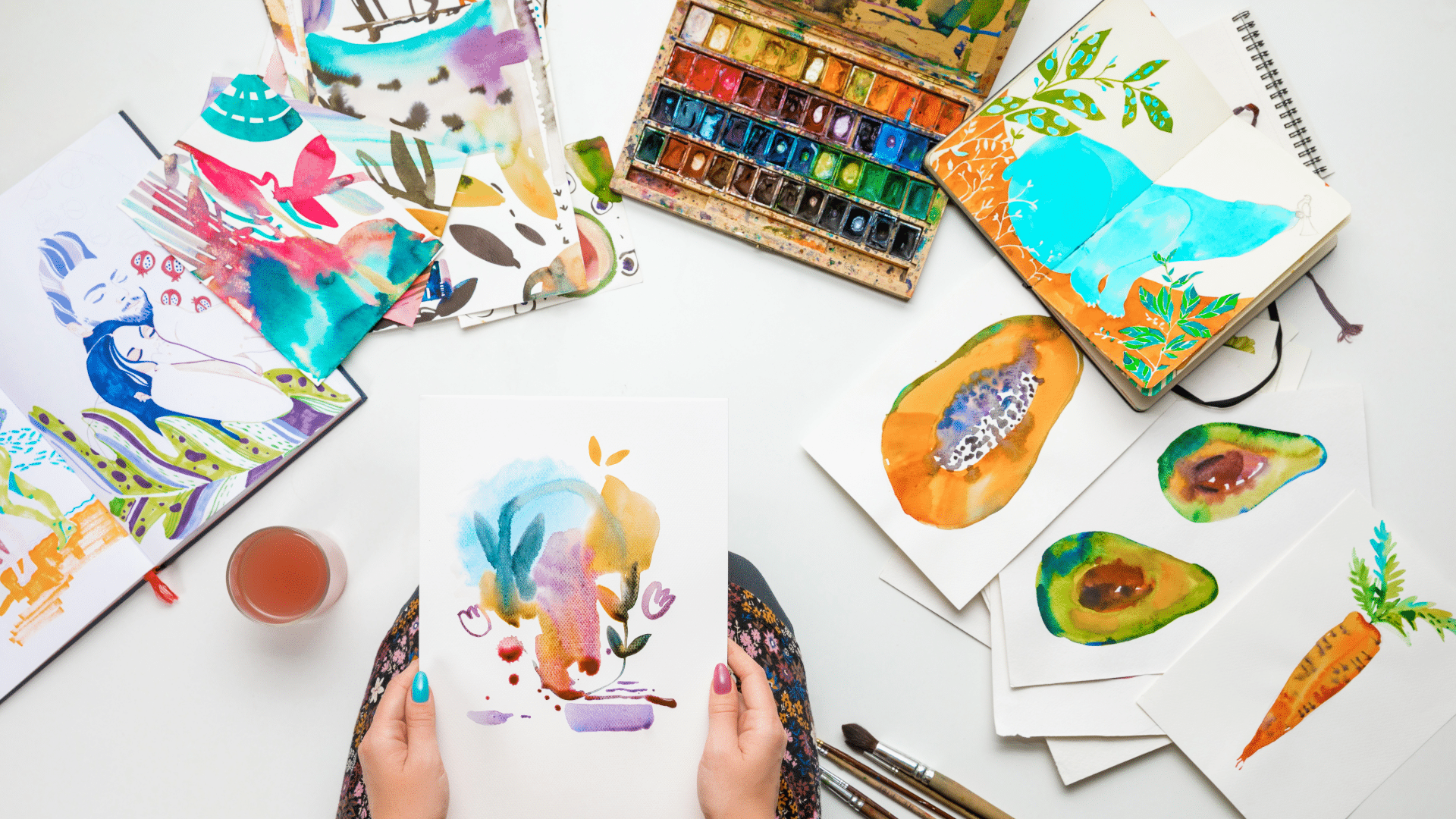
Watercolour in Practice (Summer)
Art Classes
Dates6 weeks from 18 April 202418, 25 April2, 9, 16, 23 MayAND/OR6 weeks from 6 June 20246, 13, 20, 27 June4, 11 July
Book PlaceA little previous watercolour experience is recommended for this course.
Watercolour in Practice: Eric Ravilious and Emil Nolde (April-May course)
The aim of this course is to develop solid watercolour skills whilst looking at the practice and themes of contemporary as well as traditional artists. The course will look in further detail at 2-3 artists during each module and encourage students to adopt a creative thinking practice with their own work.
We are looking for this project at the watercolours of Eric Ravilious and Emil Nolde. Ravilious’ approach involves using a barely moist brush and building the strokes up in layers. It offers excellent scope for exploring varied mark-making, composing an image and optical colour-mixing. In contrast to Ravilious carefully planned and rigorously composed method, Nolde’s work involves an instinctive free-flowing wet-in-wet approach using varied consistencies of paint and unconventional compositions.
- Drawing, design and composition skills
- Understanding watercolour washes, wet in wet and dry brush work
- Tonal values and practical understanding of colour mixing from the primaries
- Saving whites and masking techniques
Materials
Pencils in a range of softnesses e.g. HB, 2B, 6B; putty rubber; ruler; some sheets of A4 or A3 cartridge paper, A4 or A3 pad of good quality cold-pressed watercolour paper. Min. of 6 artist quality watercolour paints: warm and cool version of red, yellow and blue (suggested cadmium red, alizarin crimson, winsor lemon, cadmium yellow, ultramarine blue, cobalt blue, optional extras: viridian or winsor green). Minimum of 3 watercolour brushes: large flat or round wash brush, round brush size 5–8, fine brush size 2 or 3, large palette; approx 4 sheets A4 tracing paper; scissors; masking tape; household sponge; toothbrush.
Optional: Masking fluid; candle; 3 coloured pencils (red, yellow and blue); stencil brush(es); selection of any other brushes already owned which can include hogshair; fan or old battered brushes; scalpel; small cutting mat.
Tutor
Emily Burton
Dates
6 weeks from 18 April 2024
18, 25 April 2, 9, 16, 23 May
——————-
A little previous watercolour experience is required.
Watercolour in Practice: William Tillyer and Rebecca Hind (June-July)
The course will look in further detail at 2 artists during each module and encourage students to adopt a creative thinking practice with their own work. The artists referenced during this course are William Tillyer and Rebecca Hind. Both of these contemporary artists push the boundaries of watercolour, using it in experimental as well as traditional ways. In addition to developing skills of handling various types of watercolour wash, and colour-mixing from the primaries you will also explore abstracting from a representational image and handling wet-wet washes through paint-pouring techniques.
* Abstracting from a representational image
* Understanding watercolour washes, wet in wet, glazing and gradating.
* Tonal values and practical understanding of colour mixing.
* Controlling poured wet-in-wet washes.
* Combining elements of paint-pouring and semi-abstraction to create an atmospheric painting on the subject of the elements
Materials
Pencils, putty rubber, ruler, masking tape, some sheets of A4 or A3 cartridge paper, A4 or A3 pad of good quality cold-pressed watercolour paper, approx 4 sheets of A4/A3 tracing paper, Min. of 6 artist quality watercolour paints: warm and cool version of red, yellow and blue (suggested cadmium red, alizarin crimson, winsor lemon, cadmium yellow, ultramarine blue, cobalt blue, optional extras: permanent rose, viridian or winsor green, prussian blue). Minimum of 3 watercolour brushes: large flat or round wash brush, round brush size 5–8, fine brush size 2 or 3, large palette, art masking fluid. Optional extras: very small jars or containers with lids, craft knife or scalpel. You may already have materials which can be used.
Tutor
Emily Burton
Dates
6 weeks from 6 June 2024
6, 13, 20, 27 June 4, 11 July
Book Now
You may also be interested in...
The Under-5’s Art, Yoga & Storytelling
Art Classes, Crafts, Family Show, Music Classes, Other
🌟 Our Exciting Classes: Yoga: We stretch, we sing, we breathe, we relax! A new theme every week …
More DetailsWellbeing: Intermediate Bookmaking
Art Classes
Open to all adults. Suitable for beginners and those with a little experience. In this one-off …
More DetailsExploring Acrylic Painting, Extension
Art Classes
Open to adults with some experience (at least one course of acrylics) and an ability to work some of…
More Details